15 Years of Innovation: The Foto Master Story
In 2011, Foto Master began where two passions met: technology and the joy of a great event. Fifteen years later, we’re looking back at the ideas that grew from that meeting, from tiny flipbooks you could hold in your hand to digital graffiti, augmented reality, and mirrors that invited guests to play. Behind each product is a story, and behind each story are people who helped bring it to life.
Not everything we did was successful. You may never have heard of 3D Photo Creator, Caricature Touch (Mash It), Bobble Heads, Mini Me, or Virtual Hero. Some ideas were ahead of their time. They’re part of this story, too, and we’re opening that drawer of experiments for a little anniversary honesty and a few laughs.
Rewind with us
One idea led to another.
This is a trip through a few chapters of Foto Master’s story. Some of the footage is old. That’s part of the fun.
Before the company, there was Video Flip.
The Foto Master story began before the company itself. In 2009, Boaz started developing the Video Flip concept and provided it to his father for his rental business. Video Flip turned a short video into a printed flipbook, a small keepsake guests could hold in their hands and bring to life with a flick of their thumb.
When the concept did well in his father’s business, Boaz began commercializing it. In 2011, he officially established Foto Master. An idea developed for the family rental business had become the starting point for a company of its own.
One of our earliest archive clips, filmed in the Philippines in 2011, shows Video Flip already reaching new audiences.
 From the archiveVideo Flip in the PhilippinesA glimpse of the early years · November 2011Watch the archive →
Air Graffiti Wall: from home tests to the first event.
After flipbooks, the canvas got much bigger. Air Graffiti Wall invited guests to pick up a spray can, paint digitally, and turn a photo into a creation of their own. But before the event demonstrations, there was a box, a webcam, and plenty of testing.
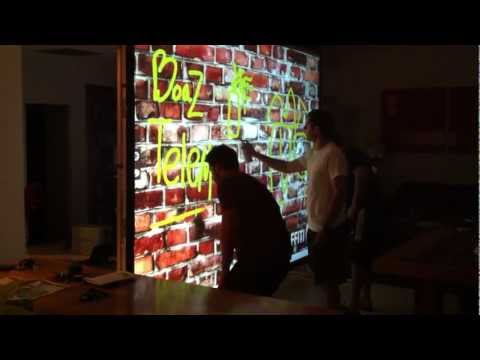
Boaz put an infrared webcam inside a box and worked on making the drawing respond quickly and accurately. Next came the search for the right rear-projection screen and tests with stencils at home. While Ron worked on the infrared spray cans, Boaz developed the software, adding printing, email, Facebook sharing, and the ability to save a video of the drawing itself.
Then family members joined in. With spray cans in hand, they helped test what happened when several people drew together. Finally, it was time to take Air Graffiti to its first event: a bar mitzvah.
These are the original clips from the 2012 development story. They’re wonderfully unpolished, and that’s what makes them such a fun part of the archive.


Watch the first Air Graffiti event →
Read the original “How It All Began” post →
Augmented Reality Photo Booth changes the scene.
With our Augmented Reality Photo Booth, guests could see themselves inside a different world, interact with virtual elements, and use hand gestures as part of the experience. Looking back at the original announcement, you can see an idea that has stayed with us: the photo is only part of the fun. What happens before it matters, too.
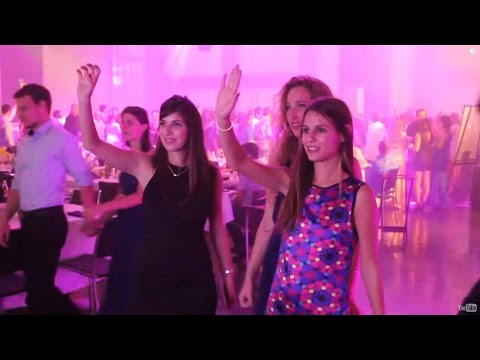 From the archiveMeet the original AR Foto BoothThe announcement and demonstration · November 2014Watch the archive →
Mirror Me Booth: a breakthrough that helped change the industry.
Mirror Me Booth became one of our biggest breakthroughs and a major innovation for the photo booth industry. A familiar full-length mirror became an interactive host, greeting guests with animations, responding to their touch, and guiding them through a photo experience they could make their own.
Guests could draw on the mirror, sign their names, and play along with creative prompts. Behind the reflection, our software let operators build their own workflows, animations, and photo layouts. That combination of hardware and software opened the door to a whole new kind of photo booth experience.
Our continued development of the mirror booth system also led to patented technology, including U.S. Patent No. 10,841,473, granted in 2020. It is an important part of the innovation story that grew from the original Mirror Me Booth.

Beauty Mirror Booth gives the magic a new shape.
With Mirror Me, we had built more than a single booth. We had created a software platform that could bring different mirror designs to life. At IAAPA 2017, we introduced Beauty Mirror Booth and Retro Mirror Booth alongside Mirror Me: three designs powered by the same Foto Master software.
Beauty Mirror Booth brought a sleek, modern presence to the family. Our software brought the familiar animations, playful interactions, and customizable workflows to this new design, giving operators another way to present the experience at their events.

Retro Mirror Booth brings a classic character.
Retro Mirror Booth explored the same idea with a different personality. Its classic look and portable design gave the family another distinctive form, with the same Foto Master software bringing the interaction to life.
Beauty and Retro showed how much could grow from that original breakthrough. Operators could choose the design that suited their style while creating their own guest experiences on a shared software platform.

Watch the original 2017 mirror family reveal →
Read the IAAPA 2017 announcement →
Photo Mosaic Wall brings every guest into one big picture.
Photo Mosaic Wall gave us a new way to bring people together. Each guest contributed a photo, and those individual moments became the tiles of a much larger image. Up close, you could find yourself. Step back, and you could see what everyone had created together.
We introduced the experience in 2018, with physical and digital mosaics growing throughout an event. Our July 2018 post already celebrated V2 and new ways to collect guest photos. The idea has kept growing ever since, including the new PMWall software in 2026.

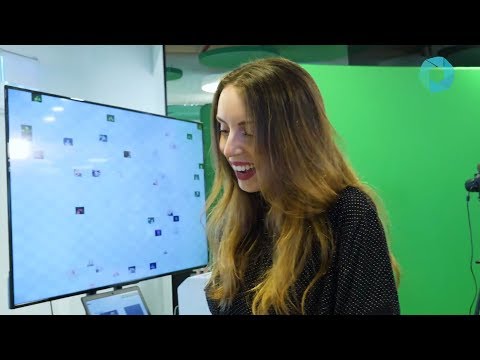
Tower Mirror Booth brings a larger presence.
Tower Mirror Booth brought its own large-scale presence to the collection. By PBX 2019, we were inviting visitors to experience the recently launched Tower alongside our other new additions. It gave the mirror family another way to make an impression at an event.

Mirror X Booth: designed to make an entrance.
We introduced Mirror X Booth at PBX 2019. It was a game changer in how a mirror photo booth could look and feel at an event. Standing six feet tall, with a 70-inch mirror and an all-mirror face, it gave the experience a striking new presence. Before guests even touched the screen, the design had already invited them over.
That presence became part of the celebration itself. At weddings, parties, and branded events, Mirror X could be a visual centerpiece as well as a place to take photos. The familiar Foto Master interactions now had a different stage, with a broad reflective surface that made the booth feel like part of the room.
There was another side to that design story: getting it to the next event. Built-in omni wheels helped operators move the booth, bringing practical transport thinking to a product with a big personality. Mirror X remains one of our best sellers today, and an important chapter in the evolution of the mirror.


Red Robot joins the story. Retro Photo Booth comes along.
Some chapters begin with an idea. This one began with a partnership. We had worked with Red Robot in Australia since 2017, and in 2019, Foto Master acquired the company. Their experience in hardware design and manufacturing opened up new possibilities for what we could build together.
Among them was the Retro Photo Booth, designed by Red Robot. We brought their design into the Foto Master family, combining its classic character with our software. It gave guests another way to enjoy the experience, and operators a compact booth they could take from one event to the next.


Pylon iPad Booth makes its debut in Paris.
In September 2019, we took the Pylon iPad Booth to IAAPA in Paris for its debut. The iPad became the center of a new booth design, bringing photo and video experiences into another form.
Looking back at the announcement brings back the familiar rhythm of a launch: pack the booth, meet the guests, show what it can do, and then catch up with the Foto Master family after the show. This time, the backdrop was Paris.

Mirror Air Booth: a new look, a different feeling.
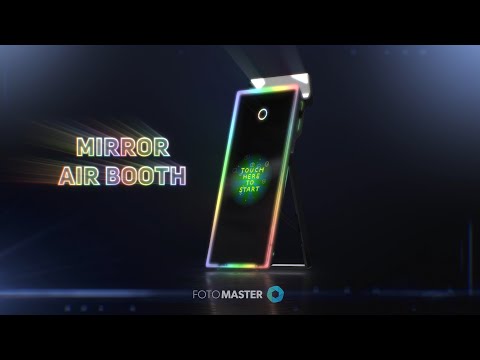
By the Marquee Show in 2021, Mirror Air Booth was joining the lineup with a new look for the mirror experience. Its 65-inch floating mirror, illuminated RGBW frame, and aluminum construction gave the experience a clean, contemporary look. The mirror seemed to float above its support, bringing a sense of lightness to a product that still made a big impression.
It was a game changer for the look and feel of an event setup. At a wedding or gala, the booth could sit naturally alongside the decor while its lighting invited guests to step closer. The design gave operators another way to present a premium mirror experience, with its own recognizable personality.
Portability was part of the picture, too. A padded case and hand truck supported the journey between venues. Together, Mirror Air and Mirror X showed how much the physical design could change the experience for both guests and operators. Both remain among our best sellers today, years after their introduction.

Spire Photo Booth joins the lineup.
Spire Photo Booth added another design to the growing Foto Master lineup. By PBX 2022, it was joining our mirror booths, Pylon, Photo Mosaic Wall, and Retro Photo Booth on the show floor.
More designs meant more ways for operators to find a booth that suited their events and their own style. The official Spire promo is a little time capsule from that chapter of the family.

V-Motion 180 changes the angle.
With V-Motion 180, we started moving the camera around the experience. Its sweeping arm captured guests from above, turning a few seconds of posing, dancing, or being wonderfully silly into a moving keepsake.
Our IAAPA 2022 announcement introduced it as a brand new addition to the lineup. The wedding clip below shows what happened when that idea met a real celebration.

Draw Me Bot turns a photo into a live drawing.
At Photo Booth Expo in February 2023, we introduced Draw Me Bot. AI and a robotic arm worked together to turn a guest’s photo into a portrait drawn right in front of them. The keepsake was fun, but watching the pen move was part of the attraction.
The early weeks were full of learning. Our March 2023 post documented improvements to faces, drawing time, and the little details that help a portrait feel like its subject. It is a lovely reminder that a launch is a beginning, and that customer feedback helps shape what comes next.

Razor Mirror Booth: the first mirror booth running on iPad.
Razor Mirror Booth brought another first to the story: the first ever mirror photo booth running on iPad. It opened a new direction for the mirror experience, bringing an iPad workflow into a slim booth designed to travel.
Powered today by FMX for iPad, Razor uses the iPad Pro’s rear camera behind a 60-inch mirror. Its five-inch-deep body pairs a full mirror presence with a compact profile. It is another example of the question that keeps us creating: where can we take this experience next?

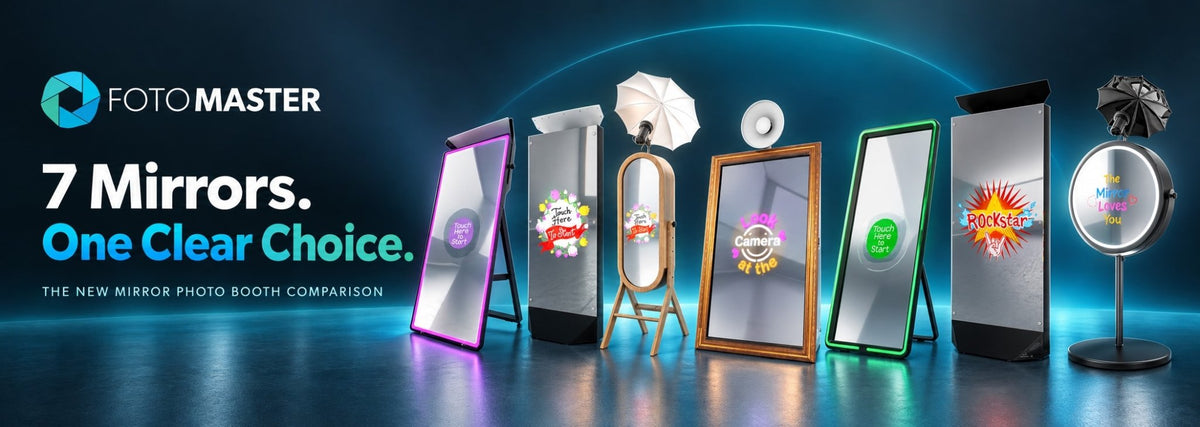
Today, Mirror Me, Beauty, Retro, Mirror X, Mirror Air, Tower, and Razor form a family of seven distinct mirror designs. Six use FMX for Windows, while Razor brings the mirror experience to FMX for iPad.
Fortuna AI gives the fortune teller a new future.
In 2025, we introduced Fortuna AI, bringing a new personality to the classic fortune teller attraction. AI palm readings, playful photo transformations, and personalized keepsakes became part of an experience guests could step into.
First unveiled at PBX 2025, Fortuna gave us another way to combine technology with a bit of theater. After flipbooks, digital spray cans, interactive mirrors, and drawing robots, a fortune teller somehow felt right at home.

And there is another idea on the way.
Fifteen years in, we are still asking what else an event experience could be. A new Foto Master product is launching in November 2026.
We’re keeping the details to ourselves for a little longer. For now, consider this a small glimpse of the next chapter. We can’t wait to show you.
The other side of innovation
Not everything we did was successful.
Some concepts never became lasting products. Others arrived ahead of their time. Alongside the products that found their place, these experiments deserve a moment in the anniversary scrapbook, too.

EARLY YEARS · ONE EXTRA DIMENSION
3D Photo Creator: please keep your glasses on.
Our early brochure invited operators to “join the 3D buzz.” Naturally, we wanted to bring that extra dimension to the party. The idea was to create a photo in which the background appeared to sit farther back and the guest seemed to pop out of the picture.
3D Photo Creator combined a green screen with red and blue image processing. Guests took home a printed photo and a pair of red and blue glasses to see the effect. A souvenir with its own dress code.
The glasses were part of the experience, right down to the logo. We even had software box artwork to match. Looking at it now, you can almost hear the pitch: yes, it is a photo, but have you tried putting these on?

It did not become one of our lasting hits. But it belongs in this story: an early experiment in making a photo feel like something more. Some ideas become the products everyone remembers. Others leave us with a very good logo and a pair of glasses.

2011 · MAKE YOUR OWN FACELIFT
Caricature Touch: your face, your questionable decisions.
Caricature Touch, also known as Mash It, put guests in charge of their own caricatures. Take a photo, put your fingers on the touchscreen, and start reshaping your face. The aim was to look funnier. Judging by these photos, subtlety was entirely optional.
This was a very different sort of photo editing. Stretch a smile, push a cheek, and see what happens. Guests could turn their photo into a caricature themselves, with a branded frame around the result. By November 2011, the software also let them choose printing, email, or both.
The original photos below capture the concept better than any sales pitch: complete concentration at the touchscreen, followed by a portrait that probably would not make it onto a passport.


Caricature Touch did not become one of our lasting successes. These pictures still earn their place in the scrapbook, though. There is something wonderfully direct about an experience that asks, “How funny can you make your own face?”
Revisit our IAAPA 2011 post →
Read the November 2011 software update →
2013 · THE GUEST BECOMES THE GAME
Virtual Hero: a big idea ahead of its time.
Virtual Hero was a big innovation and a concept ahead of its time. It took the idea of a personalized party favor into a game. We photographed guests in front of a green screen, extracted their faces, and placed them on the main characters of games they could choose. Suddenly, being the star of the party had a very literal meaning.
Guests received a personalized printout with an access code and a QR code to download their game. They could play at iPad stations during the event, then take the game home on their phones or tablets. A TV could also show a game playing automatically with a randomly selected friend’s face. Spotting someone you knew on screen was part of the fun.

We introduced Virtual Hero in October 2013 with footage from a bat mitzvah. By early 2014, we had added a high score table and more ways to play, including online and desktop versions. Your own face in the game was one thing. Having a score to beat gave friends another reason to join in.


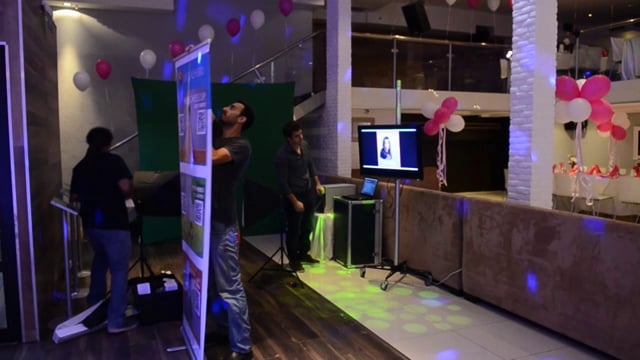
Looking back, we still love the ambition of Virtual Hero. Take a photo, become the main character, and carry a game starring you home from the event. It arrived before its moment, but a great idea does not always stay in the archive. Could Virtual Hero make a comeback soon? We might just see our hero return. :)
Read the original Virtual Hero introduction →
Revisit the 2014 game update →

2013 · A KEEPSAKE WITH A WOBBLE
Bobble Heads: a souvenir with a wobble.
For Bobble Heads, we took the guest’s photo off the screen and gave it a little shake. Their face became the head of a personalized doll, paired with an illustrated body. A small keepsake, a big head, and absolutely no obligation to keep still.
The process combined photography, software, printing, and cutting. A guest’s head was isolated from a green screen photo, placed with a chosen body design, and turned into a physical party favor with a wobbling head. Our 2014 catalog listed 50 body designs and support for custom bodies, so there was plenty of room to give each character a personality.

Our November 2013 launch post shared the attraction at a wedding. The catalog preserved two more little glimpses: the cutting process and a guest enjoying the finished result. Turning someone you know into a tiny character with an oversized head was a fairly direct route to a smile.


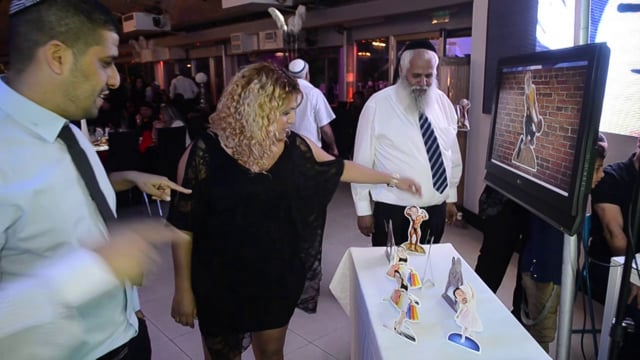
Bobble Heads did not become a huge success for us. It still earns a place in the scrapbook as one of the more playful ways we tried to turn a guest’s photo into something they could take home. This one just had a little more movement in the neck.
BY 2014 · SHRINK YOUR FRIEND
Mini Me: finally, your friend fits in your hand.
The original Mini Me Foto Booth took friendship to a smaller scale. One guest held out an open hand while a friend stood beside them. On the monitor, that friend became a tiny version of themselves, apparently standing right in the other guest’s palm. Finally, “I’ve got you” could be a photo pose.
The software removed the background automatically, without a physical green screen backdrop. Guests could find themselves on a beach, in Las Vegas, or somewhere else entirely, with a pocket-sized friend joining the scene. They could interact with the tiny version on screen, then have the photo printed at the event or sent by email.

By IAAPA 2014, Mini Me was part of the lineup we were showing alongside Air Graffiti, Augmented Reality Foto Booth, and Virtual Hero. The original making-of clip below takes us back a step further, to the experiments before the finished photo booth experience. Even the box artwork was committed to the idea: a whole person, right there in your hand.


Mini Me did not become one of our lasting products, but it remains a wonderfully playful part of the story. We were exploring what happened when guests could interact inside the picture, and apparently decided that holding a friend in your hand was a perfectly reasonable place to start. Friendship, now available in travel size.
The original Mini Me Foto Booth belongs to this early chapter. Our newer Miniature Me feature, introduced in 2025, creates photo cutout keepsakes.
Explore the original Mini Me archive →
Revisit our IAAPA 2014 post →
APRIL 1, 2016 · A VERY DIFFERENT PRODUCT LAUNCH
The Toilet Photo Booth. The joke that got sales calls.
Ten years ago, for April Fools’ Day 2016, we introduced the Toilet Photo Booth. After years of finding new places for a photo booth, we had apparently decided that the restroom deserved a turn.
And we went all in. A booth concept, promotional artwork, sample photos, and even a funny video. The campaign line said it all:
Turn your lavatory into a WOWVATORY.
Then came the part we hadn’t scripted: some customers actually called to order one.
We had set out to make people laugh. Apparently, we had also made the product a little too convincing.


Somewhere between the artwork, the photos, and those phone calls, an April Fools’ joke became one of our favorite Foto Master memories. Ten years later, we’re still laughing about that one.